|
Flyweight Pattern - WarGame Example - Java Sourcecode |
|
Java Source Code Example for the Flyweight Pattern - WarGame
Consider for example a game of war, were there is a large number of soldier objects; a
soldier object maintain the graphical representation of a soldier, soldier behavior such
as motion, and firing weapons, in addition soldier's health and location on the war
terrain. The solution is to keep the common state of soldiers in a shared object
The war game example instantiates 5 Soldier clients, each client maintains its internal
state which is extrinsic to the soldier flyweight. And Although 5 clients have been
instantiated only one flyweight Soldier has been used.
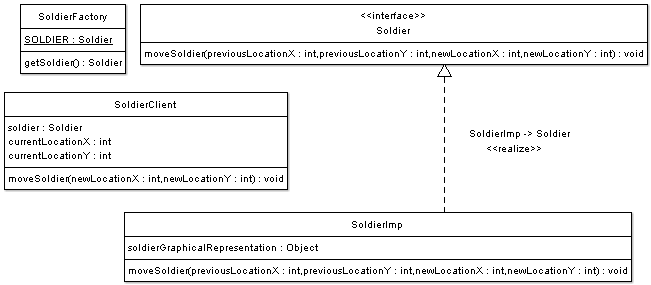
The code below shows Soldier interface which is the flyweight interface
package flyweight;

/**
 * Flyweight Interface
 *
 */
public interface Soldier {

	/**
	 * Move Soldier From Old Location to New Location
	 * Note that soldier location is extrinsic
	 *    to the SoldierFlyweight Implementation
	 * @param previousLocationX
	 * @param previousLocationY
	 * @param newLocationX
	 * @param newLocationY
	 */
	public void moveSoldier(int previousLocationX,
		int previousLocationY , int newLocationX ,int newLocationY);
}
|
The code below shows the SoldierImp which is the flyweight implementation
package flyweight;

public class SoldierImp implements Soldier {

	/**
	 * Intrinsic State maintained by flyweight implementation
	 * Solider Shape ( graphical represetation)
	 * how to display the soldier is up to the flyweight implementation
	 */
	private Object soldierGraphicalRepresentation;

	/**
	 * Note that this method accepts soldier location
	 * Soldier Location is Extrinsic and no reference to previous location
	 * or new location is maintained inside the flyweight implementation
	 */
	public void moveSoldier(int previousLocationX, int previousLocationY,
			int newLocationX, int newLocationY) {

		// delete soldier representation from previous location
		// then render soldier representation in new location
	}
}
|
The code below shows the Soldier Factory from which we instantiate Soldiers Flyweight
package flyweight;

/**
 * Flyweight Factory
 */
public class SoldierFactory {

	/**
	 * Pool for one soldier only
	 * if there are more soldier types
	 * this can be an array or list or better a HashMap
	 *
	 */
	private static Soldier SOLDIER;

	/**
	 * getFlyweight
	 * @return
	 */
	public static Soldier getSoldier(){

		// this is a singleton
		// if there is no soldier
		if(SOLDIER==null){

			// create the soldier
			SOLDIER = new SoldierImp();
		}

		// return the only soldier reference
		return SOLDIER;
	}
}
|
The code below shows SoldierClient implementation. The client uses the Flyweight soldier
reference to perform its tasks
package flyweight;

/**
 * This is the "Heavyweight" soldier object
 * which is the client of the flyweight soldier
 *  this object provides all soldier services and is used in the game
 */
public class SoldierClient {

	/**
	 * Reference to the flyweight
	 */
	private Soldier soldier = SoldierFactory.getSoldier();

	/**
	 * this state is maintained by the client
	 */
	private int currentLocationX = 0;

	/**
	 * this state is maintained by the client
	 */
	private int currentLocationY=0;


	public void moveSoldier(int newLocationX, int newLocationY){

		// here the actual rendering is handled by the flyweight object
		soldier.moveSoldier(currentLocationX,
			currentLocationY, newLocationX, newLocationY);

		// this object is responsible for maintaining the state
		// that is extrinsic to the flyweight
		currentLocationX = newLocationX;

		currentLocationY = newLocationY;
	}
}
|
The code below shows the war game implementation. Note that war game instantiates 5
Soldier clients, each client maintains its internal state which is extrinsic to the
soldier flyweight. And Although 5 clients have been instantiated only one flyweight
Soldier has been used.
package flyweight;

/**
 * Driver : War Game
 */
public class WarGame {

	public static void main(String[] args) {
		// start war

		// draw war terrain

		// create 5 soldiers:
		SoldierClient warSoldiers [] ={
				new SoldierClient(),
				new SoldierClient(),
				new SoldierClient(),
				new SoldierClient(),
				new SoldierClient()
		};

		// move each soldier to his location
		// take user input to move each soldier
		warSoldiers[0].moveSoldier(17, 2112);

		// 	take user input to move each soldier
		warSoldiers[1].moveSoldier(137, 112);

		// note that there is only one SoldierImp ( flyweight Imp)
		// for all the 5 soldiers
		// Soldier Client size is small due to the small state it maintains
		// SoliderImp size might be large or might be small
		// however we saved memory costs of creating 5 Soldier representations
	}
}
|
|
|
